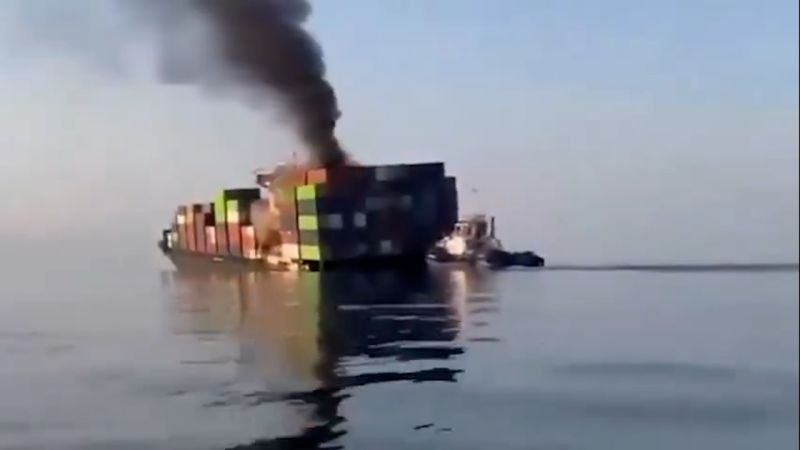
STRAIT OF HORMUZ — A Singapore-flagged container ship has sunk in the Strait of Hormuz after being hit by a projectile, one of two merchant vessels lost near the waterway in 24 hours as attacks on shipping in the Gulf climb to their highest level since the US-Iran war began in February.
GFS Pride lost, sister ship damaged
The 2,824-TEU container ship GFS Pride was struck on Tuesday, October 13, while transiting the strait. Fire broke out on board, and the vessel went down on Wednesday. US Central Command (CENTCOM) said it sank while under tow. All 21 crew were taken off safely with no injuries reported, according to the Maritime and Port Authority of Singapore (MPA).
Her sister ship, the Singapore-registered GFS Giselle, was hit in the same wave of attacks and suffered hull damage, but reached a safe anchorage under her own power with all 22 crew unharmed. Both ships are managed by UAE-based GFS Ship Management.
Singapore condemned the strikes as “unprovoked, unjustifiable, and a breach of international law.”
Within the same 24 hours, the Antigua and Barbuda-flagged bulk carrier Cape Dao sank close to the strait, weeks after a projectile strike on September 23 that killed one crew member. According to an analysis of International Maritime Organization (IMO) casualty data reported by Reuters, the two are only the second and third large ships sunk since the war began on February 28. The first was the Maltese-flagged container ship Safeen Prestige, hit in March.
Mine or missile? Competing claims
Iran’s Islamic Revolutionary Guard Corps (IRGC) claimed, without offering evidence, that GFS Pride hit a naval mine while using an “unauthorised” route along the Omani coast, and said the ship was carrying more than 2,500 containers, including alleged contraband. CENTCOM rejected that account, saying an IRGC projectile struck the vessel and that the main shipping lanes are clear of mines.
The Joint Maritime Information Center (JMIC) said it had seen no evidence supporting the mine claim, though it still warns of possible mining in and around the traffic separation scheme. Maritime security firm Marisks also found no independent evidence of a mine and described Iran’s statements as consistent with a psychological-operations campaign.
Videos circulating online show the listing ship under heavy smoke with containers drifting nearby. Pakistan’s maritime authority warned mariners about floating containers in the area. Social media posts claiming that small boats were scooping up cargo, including viral images of floating iPhones, could not be verified, and some images appeared to be AI-generated, The National reported.
Attacks at a new high
Attacks have surged since late September. At least six vessels were hit on Sunday, October 11, alone, and JMIC documented eight projectile attacks on October 11 and 13 against four tankers and four container ships. Off Sohar, Oman, the products tanker Petro Dolphin was attacked, and two of her crew are missing.
- 149 confirmed vessel incidents in the region since March 1 (JMIC)
- 113 confirmed incidents and 24 seafarers killed as of October 14 (IMO)
- About 30 a day: US-escorted transits from October 11 to 14, roughly 22% of the pre-war average of about 138 daily transits
- More than 430 ships waiting at anchor off Fujairah, Khor Fakkan, Dubai, Ras Al Khaimah, Musandam and Sohar
JMIC keeps the strait’s threat level at SEVERE, saying deliberate hostile action against merchant ships is “highly likely.” The center’s warnings include IRGC drone overflights, radio hails attempting to steer ships onto a northern, Iranian-controlled route, and higher targeting risk for vessels broadcasting their AIS positions.
Who controls the strait?
CENTCOM insists that “American forces and regional partners clearly control the Strait of Hormuz.” It cited more than 40 commercial transits in a 24-hour period and said US forces had helped Gulf partners move more than 19 million barrels of crude through the strait in a single day. The IRGC Navy says Iran still controls the waterway.
Meanwhile, the US is enforcing a blockade of Iranian ports. As of October 10 to 11, US forces had redirected 135 commercial vessels and disabled four. Iran says its escalation is a response to that blockade and to sanctions introduced last month. Two senior Iranian officials told Reuters that Tehran is using new tactics against shipping to keep oil prices high and to influence the November 3 US midterm elections. One warned that ships would be safe nowhere, even outside the strait.
“The threat is not confined to tankers, with container vessels and bulk carriers also sustaining serious damage,” Marisks said.
What it means for mariners
With the Black Sea also seeing a wave of drone strikes on merchant ships this month, two of the world’s key maritime chokepoints are now active conflict zones. Any vessel operating in or near the Gulf of Oman and Persian Gulf, including yachts on delivery or passage routes, should follow UKMTO and JMIC advisories, register with UKMTO, and keep watch for floating containers and debris near the GFS Pride wreck site.
Sources: gCaptain, gCaptain / JMIC, Reuters via gCaptain, The National. This is a developing story.
Leave a Reply