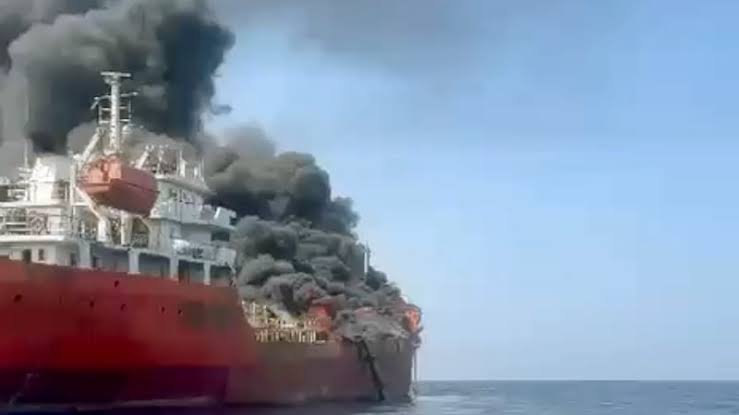
Seven merchant ships hit in a fortnight. At least 23 sailors dead or missing. Insurers now treat almost the entire Black Sea as a war zone. NATO says it has seen enough.
NATO announced on Tuesday, 20 October, that it is sending additional maritime patrol aircraft, radar systems, drones and intelligence personnel to the Black Sea, after a wave of drone strikes on commercial shipping reached the doorsteps of two alliance members, Romania and Bulgaria.
The decision followed an emergency discussion of Black Sea security by NATO ambassadors at the North Atlantic Council in Brussels. Alliance spokesperson Allison Hart said the new assets would focus on surveillance, reconnaissance and forensics, adding that NATO had already strengthened its eastern flank “including with counter-drone capabilities.”
A fortnight of fire at sea
The roll call of damaged and sunk vessels has grown almost daily this month, with most strikes landing in the exclusive economic zones of Romania and Bulgaria:
- A Turkish-owned grain carrier loaded with corn caught fire and sank off Romania. Two crew died and 11 were rescued.
- Two ships in Bulgarian waters were hit by combined sea and aerial drones. A Togo-flagged vessel went down with 12 sailors unaccounted for, while a Bulgarian ferry evacuated 18 crew from a damaged Palau-flagged ship.
- Chelsea 3, a Maltese-flagged, Ukraine-operated cargo ship, was struck by three aerial drones; all 15 crew were evacuated. The same day, HS Dignity was hit, and 11 of its crew remain missing.
- Yara J and Wine Trader, two chemical tankers bound for Romania, were set ablaze near the Sulina canal, the Danube’s gateway to the sea. Seven of Wine Trader‘s crew are missing.
Search crews have repeatedly found overturned lifeboats and empty lifejackets rather than survivors.
The “double tap”
Analysts say the death toll is being driven by a brutal tactic: an aerial drone strikes first, then an explosive-laden surface drone follows. Those sea drones can carry up to half a tonne of explosives, enough to sink the smaller vessels that ply the Danube canal system within minutes.
Maritime risk firm Ambrey says attacks on Black Sea shipping have surged since July, and estimates Russian forces are behind around 80% of them. Its senior analyst, Tomas Alexa, described an escalation “both in terms of the number of attacks” and in how far they reach.
Moscow has not claimed the strikes near Romania and Bulgaria, and NATO has formally attributed them to no one. But on the same day as NATO’s announcement, Russia’s military openly said it had hit three cargo ships in Ukraine’s Danube port of Reni and two more heading for Odesa.
“Words are not enough”
Pressure has been building on the alliance to move faster. Romanian President Nicușor Dan promised “a reaction from the Romanian state,” while Bulgarian Prime Minister Rumen Radev told parliament that the attacks clearly benefit Russia, conceding: “The problem is that we cannot prove it.” That is why NATO forensic teams are now combing recovered drone debris, including on the towed-in hull of Chelsea 3.
Romania is not waiting. Its jets shot down two suspected Russian drones over the weekend near Sulina. Defence Minister Radu Miruță said the drones were flying at around 450 km/h and were likely Russian-made Geran-4 turboprop models, calling it the first time Romania had downed drones of that kind. The country has logged 35 unauthorised drone incursions this year, up from nine in 2025, and has shot down six drones, compared with none last year.
France has sent a maritime reconnaissance aircraft to Romania. Bulgaria has asked NATO for combat jets and anti-drone systems, approved a larger order of German IRIS-T air defences and is joining Drone Edge, NATO’s $40 billion, five-year counter-drone programme, which Romania has already signed up to.
The legal grey zone
Most strikes have landed outside NATO territorial waters, in exclusive economic zones, and analysts say it is unclear whether Article 5, the alliance’s mutual-defence clause, covers attacks there. Some allies have instead floated Article 4 consultations. NATO’s options at sea are also limited: under the 1936 Montreux Convention, Turkey controls naval access through its straits, and allied warships have stopped rotating into the Black Sea since 2022. Ankara is reportedly weighing a meeting of Black Sea states to plan an escort mission.
The bill lands on trade
London’s insurance market now rates nearly the whole Black Sea as high-risk, sparing only the territorial waters of Turkey, Romania, Bulgaria and Georgia. Premiums are climbing, some operators are pulling out, and industry voices warn the region risks becoming a commercial “dead zone.” The stakes are highest for Ukraine, whose grain exports, the backbone of its wartime economy, depend on these routes. For now, ships continue to queue at Romania’s port of Constanța, waiting to see whether NATO’s eyes in the sky can make the water safe again.
Sources: The Guardian, Reuters, Associated Press (via PBS NewsHour), IBTimes UK.